About our Loons
Home » Water’s Edge »
About Our Loons Bulrushes Dock Talk Fertilizer Regs Floating Bogs Gardening Septic Info
Loons
Minnesota's state bird, the common loon, is more at home in the water than on land. Built like a torpedo, it swims under water in search of prey. Minnesota has more common loons (roughly 12,000) than any other state except Alaska.
Loons are good indicators of water quality because they need clean, clear water to observe and catch food. They are also sensitive to disturbance and lakeshore development, and are indicators of the effects of contaminants like lead and mercury in the water.
Volunteer
The Minnesota Loon Monitoring Program (MLMP) is a great way to get involved with wildlife, particular loons, on Lake Miltona. The DRN monitors loon populations with the help of volunteers to improve understanding of what our state bird needs to maintain a strong, healthy presence in Lake Miltona. Become a volunteer (pdf) today and help monitor the state bird.
Thanks to the efforts of hundreds of volunteers, the DNR has over 20 years of data. This long-term data set gives the DNR the ability to detect significant changes in the adult population and reproductive success of the state's common loons, and to anticipate any problems that could jeopardize the future of our state bird.
During a 10-day period in the summer, volunteers count the number of adult and juvenile loons seen, and report these observations for data management and analysis.
Help Protect Our State Bird - Own your chicks!
Loon Nesting Areas
The sign pictured to the left is posted at all of the public access boat launch locations.
- Do not approach loon nests
- Do not approach loon families
- Loons are a protected species
Loons don't begin breeding until they are three or four years old. The male chooses a territory and attracts a mate. Together they build a nest out of reeds and grasses on the edge of the water. They take turns incubating the one or two eggs. After 28-30 days blackish brown chicks emerge from the eggs, soon ready to swim.
Dead Loons
The DNR is asking all lake residents to report the findings of any dead loons to your local DNR office. They will confiscate the birds for examination of lead and mercury levels.
Fun Facts
- The bones of most birds are hollow and light, but loons have solid bones.
- The extra weight helps them dive as deep as 250 feet to search for food.
- They can stay underwater for up to five minutes.
- Because their bodies are heavy relative to their wing size, loons need a 100-600 foot "runway" in order to take off from a lake.
- Loons can fly more than 75 miles per hour.
- The red in the loon's eye helps it to see under water.
- Scientists think loons can live for 30 years or more.
Back to Top of Page
Loon Nesting Platforms
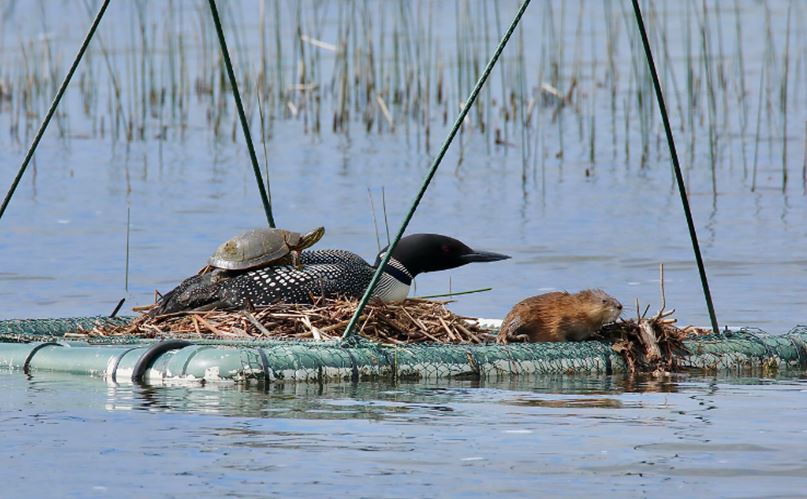
loons on a platform 2021 Submitted by Scott Rykken.
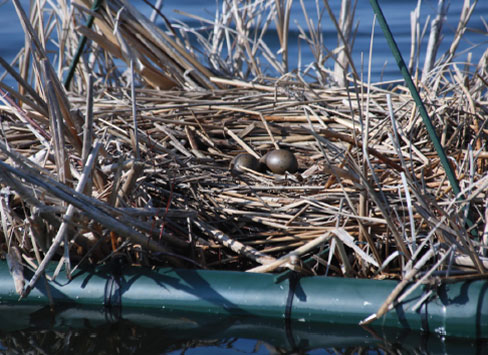
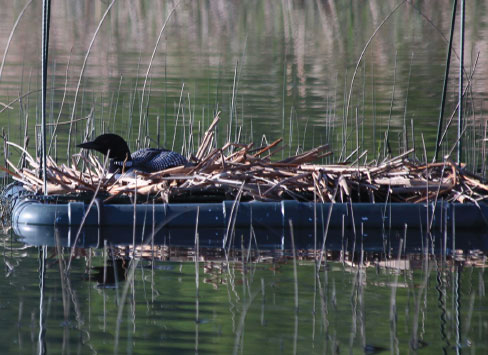
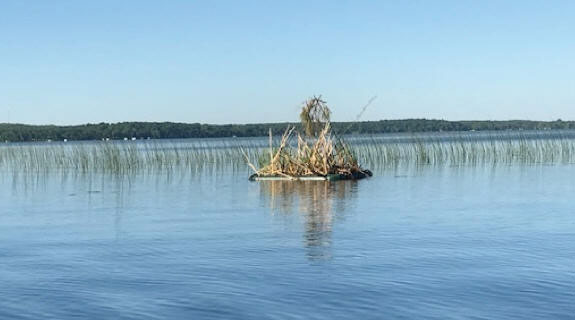
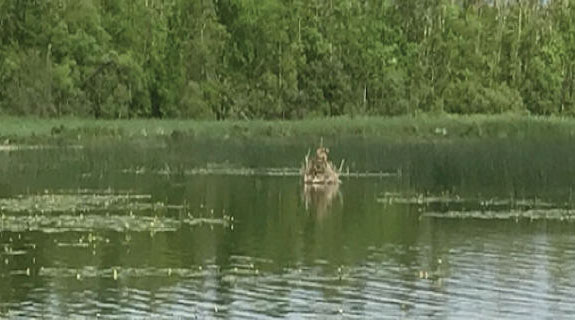
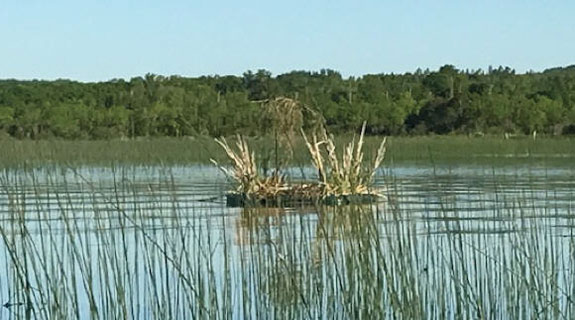
Tom Struthers and Randy Hansen started the loon nesting platform project in 2017 by building and placing 2 loon-nesting platforms in Lake Miltona. It has since expanded to having 6 platforms. The loon nesting platforms are built using 4-inch PVC pipe as the flotation of the platform. The platform is 5' x 5' and painted green and dressed with cattails around it to make it look natural. The cattails also act as an eagle-deterrent cover. Depending on ice out, the platforms are usually deployed by the end of April.
THANK YOU to all the volunteers that not only helped build the platforms, but also place and remove them. A special thanks to Marlene Schoeneck and her Environment Science class at Parker's Prairie High School for constructing two of the platforms.
For the 2025 season, 2 of the 6 platforms were used for nesting, and both had successful hatchlings. In addition, its believed there has been an increase in natural nests, with at least 8 nests being observed and many loon families with baby chicks can be seen on the water. Lake Miltona shore owners who take lake stewardship seriously and who work hard to protect the lake's natural habitats contributes greatly to a healthy loon population in our area. THANK YOU to all who continue these efforts.

PLEASE STAY BACK
As a reminder, during nesting season, please stay about 100 yards away from a loon nesting platform.
The platforms are currently placed west of the east landing, the east and west side of Tamarac Bay, by Smokey Timbers, the west side of the west (Lucky Acres) bay, and 6) east side of the sandbar.
Fun Facts
- The bones of most birds are hollow and light, but loons have solid bones.
- The extra weight helps them dive as deep as 250 feet to search for food.
- They can stay underwater for up to five minutes.
- Because their bodies are heavy relative to their wing size, loons need a 100-600 foot "runway" in order to take off from a lake.
- Loons can fly more than 75 miles per hour.
- The red in the loon's eye helps it to see under water.
- Scientists think loons can live for 30 years or more.
Back to Top of Page
Loons Give 'em Space
https://www.latimes.com/archives/la-xpm-1987-08-16-vw-1879-story.html
“Loons are so skittish. It’s important that neither the male nor the female sitting on the nest be frightened away. (Because) crows, cranes, raccoons, skunks and other birds and animals hang around waiting for the parent to leave the nest unattended,” Thoma said. “A loon’s egg is a fine feast for a predator,” added the wildlife biologist who has studied loons on Minnesota lakes all his adult life.
Loons are tremendous divers, according to Thoma, who said it’s impossible to tell male from female loon from afar--because one parent always stays on the nest while the other’s out diving for fish to eat. When boats get too close to a loon nest, Thoma added, the bird flys away, abandoning the eggs to predators.
Loons spend about seven months in Minnesota, McIntyre said, then fly to the Atlantic Coast where they winter offshore, feeding on fish. They arrive in Minnesota in April and May, with the thawing of the lakes, and leave in late September and October.
“Loons mate for life. They return to the same lakes each year. We know that by the yodel of the male, a different and distinct one from the other,” the ornithologist explained.
“One of the most cherished moments for a Minnesotan is to see a newborn jet black ball of fluff riding on its parents’ back during the first couple of weeks of its life.”
DISTANCE
View loons from a respectful distance of at least 200 feet.
You invite predators to eat the loon eggs and chicks if you flush a loon off its nest or separate the chicks from the adults.
Back to Top of Page